Having spent more than three decades in the renewable energy insurance market, I’ve learned that ambition in this sector is rarely in short supply. What is often in shorter supply is readiness.
I was reminded of that recently while speaking at an industry forum in South Africa, and it’s a theme I’ll return to again at an upcoming event in Sydney. Both discussions focus on their respective national transitions, but the themes could just as easily apply in Europe, North America, Asia or the Middle East.
Ambitious targets. Accelerating capital deployment. Increasing technological complexity. And one persistent question: is the insurance market truly ready for the scale and speed of the global green transition?
Independent analysis suggests that achieving net zero by 2050 will require at least USD 9 trillion of investment globally by 2030, outside of China. That figure also excludes the nearly USD 7 trillion in capital expenditure expected to flow into data centres by the end of the decade - much of it driven by AI demand, according to McKinsey.
However, you cut the numbers, we are talking about investment measured in trillions.
From offshore wind in Europe to utility-scale solar in the United States, battery storage deployment in Australia and South Africa, hydrogen ambitions in the Middle East, and large-scale grid expansion across Asia, the direction of travel is unmistakable.
Renewable generation is increasingly cost-competitive with fossil fuels. Storage technology continues to evolve rapidly. Private capital is mobilising. There is no meaningful return to the ‘old days’.
Yet, while capital and technology are accelerating, underwriting standards, modelling capability, product design and innovation, and market coordination must scale at the same pace.
One uncomfortable truth is that the insurance market’s experience with fossil fuels remains deeper and more standardised than with renewables.
Coal and gas have benefited from decades of underwriting data, established loss histories, benchmarked pricing models and well-developed policy wordings across upstream, downstream and construction risks. By contrast, renewable energy insurance is younger, more heterogeneous, and more exposed to evolving technology risks intersecting with climate, regulatory and political uncertainty, and the green transition.
The renewables sector has matured significantly over the past twenty years. But underwriting models for solar, wind and particularly storage assets are still evolving.
If we are to support a USD 9 trillion buildout, we must acknowledge that parts of the market remain siloed. Too often, insurers and brokers speak primarily to each other rather than engaging deeply with lenders and developers. If insurance is to enable the transition at scale, dialogue across the full financial ecosystem must become the norm rather than the exception.
The battery energy storage (BESS) market illustrates both the opportunities and the challenges.
In less than a decade, storage has shifted from peripheral to centre stage. Costs have fallen dramatically and deployment has accelerated. In markets like Australia, and to a lesser extent South Africa (for now), batteries are now central to system stability and renewables integration.
However, we have learned before that rapid deployment without technical discipline can destabilise capacity. Thermal runaway, aggregation risk and construction quality remain material concerns. Capacity volatility following losses helps no one, least of all developers seeking long-term certainty.
As TMGX’s own Michael Carrington explores in this edition’s Q&A on battery storage , the evolution of BESS presents enormous opportunity, but it also demands a deeper understanding of engineering standards, system design, fire mitigation and aggregation exposure. The message is clear: scaling safely requires underwriting discipline and deeper knowledge of the technology.
The lesson is not to pull back. It is to lean in with technical expertise, consistent underwriting and long-term commitment.
The exponential growth of AI-driven data centres adds another layer of complexity.
These facilities integrate property, on-site generation, high-density electrical systems, cooling infrastructure and highly sensitive IT equipment into a single interdependent risk. Historically, these components might have been financed and insured separately. Increasingly, they are structured as integrated assets with consolidated lending.
Insurance markets must adapt accordingly.
Data centres demand 24/7 uptime, zero tolerance for interruption and often co-located generation or storage. Construction timelines can stretch from two to five years, creating challenges around phased handovers, valuation accuracy and a seamless transition between construction and operational. GPU replacement values are shifting rapidly. Grid interconnection delays and transmission bottlenecks are introducing further uncertainty.
At a global level, AI-related infrastructure could attract trillions in additional capital expenditure this decade. Whether we view that development with enthusiasm or scepticism, it will materially shape power demand – and therefore renewable deployment.
The question is not whether insurers participate. It is whether we understand the technology deeply enough to underwrite it responsibly.
Wind, solar and storage are now familiar territory for much of the market. But the next wave of green transition technologies is already advancing with hydrogen, fuel cells, small modular reactors and nuclear fusion.
Fusion, in particular, is moving from state-backed research to privately funded demonstration projects. Unlike traditional fission reactors, fusion reactions are inherently self-limiting, offering a fundamentally different catastrophic risk profile. Yet ‘first-of-a-kind’ engineering challenges remain significant, and underwriting frameworks are still in their infancy.
As discussed in this edition’s Q&A with NC Fusion , the risk characteristics of fusion differ a lot from legacy nuclear technologies, but they are not risk-free. Construction complexity, technology validation and long development timelines will all test underwriting appetite and modelling capability.
If we wait for perfect data, we will always be behind the curve. If we move without discipline, we risk repeating past boom-and-bust cycles seen historically in renewables.
Targets alone do not deliver the green transition. Grid upgrades, planning reform, permitting, and a strong insurance market are just as critical. In many countries, political ambition runs ahead of physical infrastructure.
Renewables may now offer the lowest levelised cost of electricity in many markets, even when storage is included. But without transmission buildout and system integration, projects stall.
Insurance cannot solve grid bottlenecks or regulatory delays. But it can either exacerbate or alleviate financing friction. Inconsistent coverage, volatile pricing or abrupt capacity withdrawal create uncertainty that flows directly into project economics.
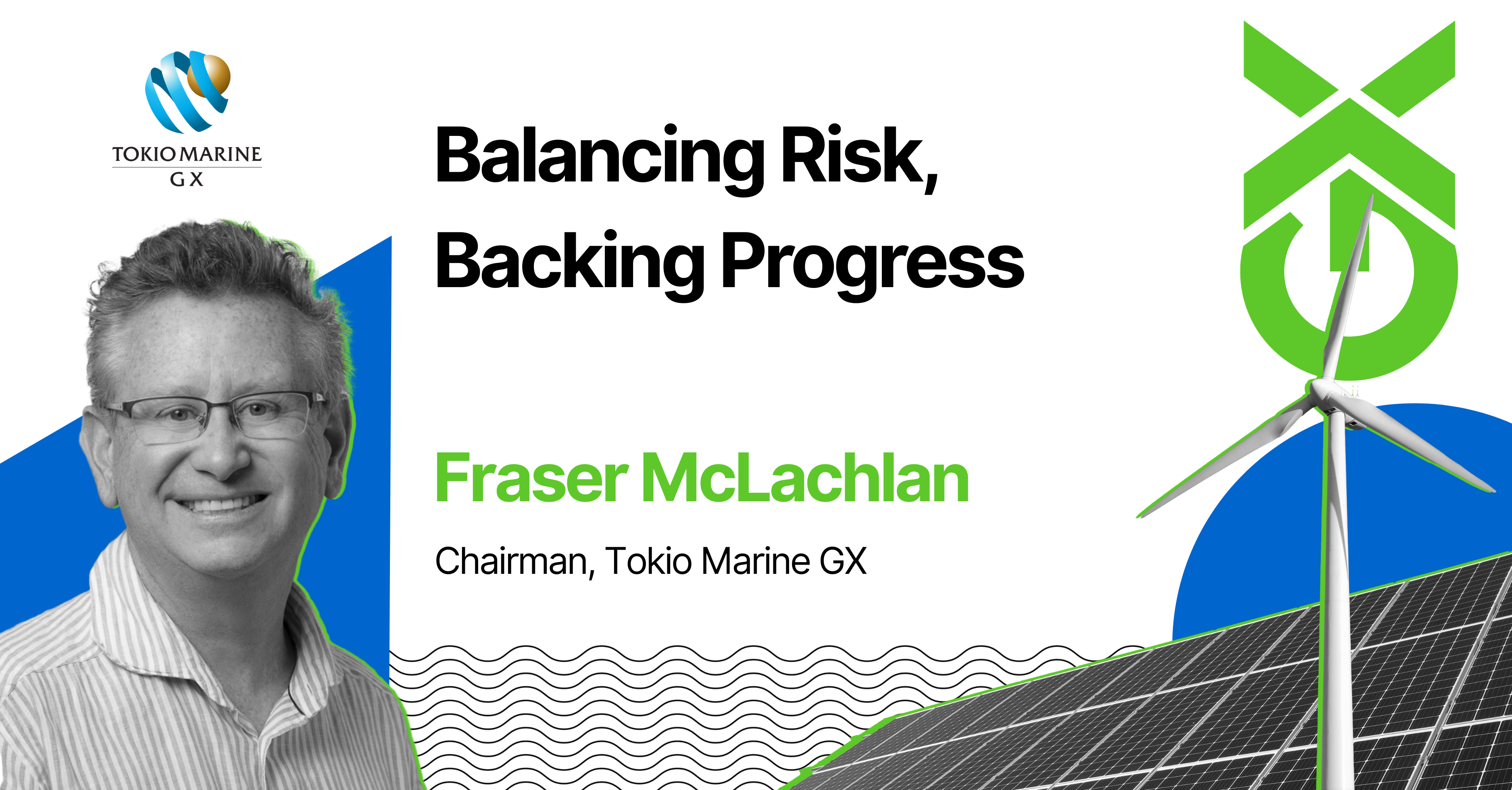
Therefore, the green transition demands a dual approach from insurers: balancing risk while backing progress.
We have lived through cycles where capital flooded into emerging technologies, pricing discipline weakened, and retrenchment followed losses. The renewables insurance sector has matured considerably. However, we are not immune from repeating past mistakes if short-term premium takes precedence over long-term sustainability. For TMGX, supporting the green transition does not mean underpricing risk. Nor does prudence mean resistance to innovation.
If the global green transition is to succeed at the required scale, insurance must do more than participate. It must enable - through robust modelling, expert underwriting, consistent and specialist capacity, and genuine engagement across the capital stack.
TMGX allows us to bring these elements together to provide holistic, deeper support for the new era of global decarbonisation.
So, is the insurance market supporting the green transition? To a degree, yes.
Are we fully prepared for it on a global scale? There is still more work to be done…
The green transition opportunity is extraordinary. The responsibility is equally significant. As ambition scales, so too must our discipline.
These themes, alongside broader insights will be explored in detail at our upcoming Risk Seminar in Bordeaux on 12–13 May. We look forward to welcoming you there.
All the best,
Fraser